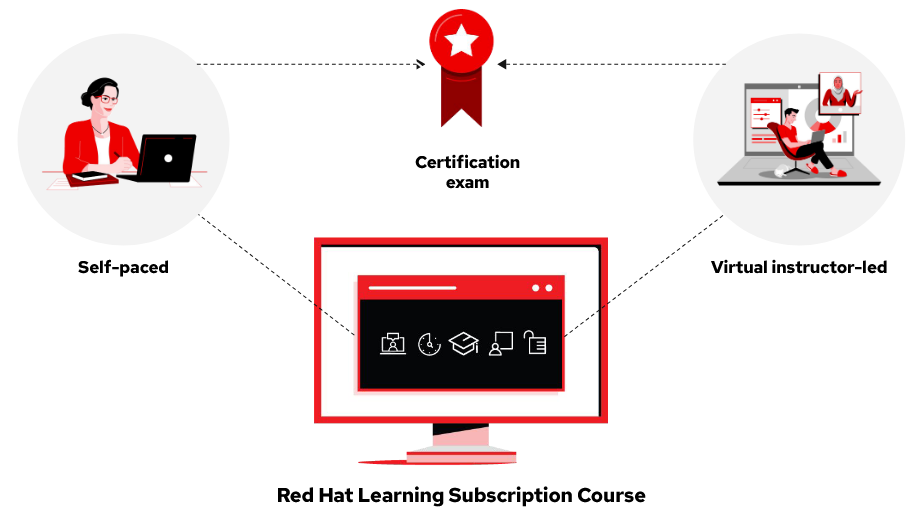
Course Overview
Create and manage virtual machines on OpenShift using the Red Hat OpenShift Virtualization operator.
Who should attend
- Virtual Machine Administrators interested in moving virtualized workloads from traditional Hypervisors to OpenShift Virtualization
- Kubernetes Administrators (Cluster Administrators, Clusters Engineers) interested in supporting containerized and virtualized workloads in the same OpenShift cluster
- Site Reliability Engineers interested in using GitOps and Ansible Automation to manage Virtual Machines on OpenShift
Certifications
This course is part of the following Certifications:
Prerequisites
- Red Hat OpenShift Administration I: Operating a Production Cluster (DO180) is recommended but not required.
Course Objectives
Impact on the Organization
- OpenShift Virtualization allows organizations to realize operational savings by managing virtualized workloads and containerized workloads together using the same orchestration and clustering infrastructure provided by Red Hat OpenShift.
- Deploying Virtual Machines (VMs) on OpenShift also eases integration of traditional server-based applications with more modern cloud-native applications and their supporting practices such as CI/CD, DevOps, and SRE to take advantage of quicker time-to-market and other benefits from these practices, without having to first redesign virtualized workloads as container-native workloads.
Impact on the Individual
- IT professionals will learn to deploy and manage virtualized workloads on OpenShift
Detailed Course Outline
Introduction to OpenShift Virtualization
Describe the features and use cases of OpenShift Virtualization.
Run and access Virtual Machines
Create, manage, inspect, and monitor virtual machines in Red Hat OpenShift Virtualization.
Configure Kubernetes network for Virtual Machines
Configure standard Kubernetes network objects and external access for VMs and virtual machine-backed applications.
Connect Virtual Machines to external networks
Configure node networking to connect virtual machines and nodes to networks outside the cluster.
Configure Kubernetes storage for Virtual Machines
Manage storage and disks for VMs in Red Hat OpenShift.
Virtual Machine template management
Create and manage templates to provision virtual machines.
Advanced Virtual Machine management
Import, export, snapshot, clone, and live migrate a virtual machine and initiate node maintenance.
Configure Kubernetes high availability for Virtual Machines
Configure Kubernetes resources to implement high availability for virtual machines.
Course Content
Managing Virtual Machines with OpenShift Virtualization with exam teaches the essential skills required to create and manage virtual machines (VM) on OpenShift using the Red Hat OpenShift Virtualization operator. This course does not require previous knowledge of containers and Kubernetes. The ! is included in this offering.
This course provides:
- Skills required to create, access, and manage VMs on OpenShift clusters
- Skills required to control usage and access of cpu, memory, storage, and networking resources from VMs using the same Kubernetes features that would also control usage and access to these resources for containers
- Sample architectures to manage High Availability (HA) of VMs using standard Kubernetes features and extensions from OpenShift Virtualization
- Strategies to connect VMs on OpenShift to data center services outside of their OpenShift cluster, such as storage and databases
Course Content Summary
- Create VMs from installation media and disk images
- Access text and graphical consoles of a VM
- Connect to VMs using Kubernetes networking (services, ingress, and routes)
- Provision storage to VMs using Kubernetes storage (PVC, PV, and storage classes)
- Start, pause, and stop VMs
- Clone and snapshot VMs
- Connect VMs to external and extra networks (outside of the Kubernetes pod and service networks)
- Provision load balancer services for VMs and then use the services to enable SSH access to VMs
- Connect VMs to host storage and external storage
- Create VMs from VM Templates
- Migrate VMs from compatible hypervisors